
- 3876 Industrial Ave, Rolling Meadows, IL 60008
- Info@auctuselectro.com
- 3876 Industrial Ave, Rolling Meadows, IL 60008
- Info@auctuselectro.com

Custom Wire Harness Assembly Design Guide
- Home
- Custom Wire Harness Assembly Design Guide

Custom Wire Harness Assembly Design Guide: 5 Decisions That Impact Performance and Cost
At Auctus Electro Assembly, we have spent over 60 years engineering wire harnesses for medical, industrial, aerospace, and commercial applications. We have seen designs that worked beautifully—and designs that created problems no one anticipated.
This guide walks you through five critical design decisions. Get them right, and you build a harness that delivers performance, reliability, and value. Get them wrong, and you inherit cost overruns, field failures, and production delays.
Decision 1: Conductor Selection — Stranding and Material
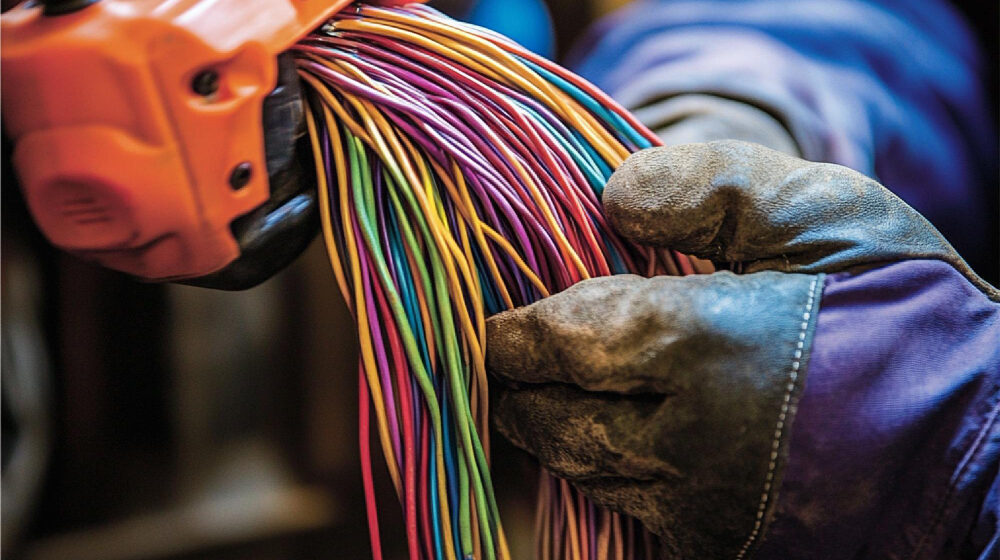
The conductor is the heart of your harness. It carries power or signal. Its construction determines flexibility, current capacity, and lifespan.
Stranding: Solid vs. Stranded
- Solid conductors are a single wire. They are inexpensive and work well in stationary applications—inside a control cabinet, for example. But they fatigue and break under vibration or flexing.
- Stranded conductors use multiple small wires twisted together. Higher strand counts mean greater flexibility. For applications involving motion robotic arms, cable carriers, vibrating equipment—high-strand conductors are essential.
Material: Copper vs. Alternatives
- Copper is the standard. Excellent conductivity, reasonable cost, easy to terminate.
- Tinned copper adds corrosion resistance—critical for marine or high-humidity environments.
- Aluminum is lighter but requires larger gauges for equivalent current capacity. Termination requires special care to avoid galvanic corrosion.
Decision 2: Insulation and Jacket Materials — Protecting the Conductors
Insulation surrounds each conductor. The jacket protects the entire bundle. Together, they determine where your harness can survive.
Common Materials and Their Applications
Material | Key Properties | Best For |
PVC | General purpose, flexible, cost-effective | Indoor commercial, consumer products |
PUR | Tough, oil-resistant, abrasion-resistant | Industrial, factory floor, continuous flex |
TPE | Rubber-like flexibility, good grip | Medical devices, test leads |
Silicone | Extreme temperature range (-65°C to 200°C) | High-heat environments, cold flex |
FEP/PFA | Chemical resistant, high temperature | Aerospace, medical, harsh chemicals |
Critical Factors
- Temperature range: A harness rated for -20°C to 60°C will fail in an industrial oven or freezer.
- Chemical exposure: Cutting fluids, hydraulic oil, cleaning solvents—each attacks different materials.
- UV resistance: Outdoor installations need UV-stabilized jackets.
- Abrasion resistance: Harnesses dragged across floors need tough outer layers.
Decision 3: Connector Selection — The Interface Matters Most
The connector is where your harness meets the world. It is also the most common failure point.
Electrical Requirements
- Pin count: Enough for current needs, with room for future expansion?
- Current rating: Each contact must handle the required amperage.
- Voltage rating: Insulation must withstand peak voltages.
- Impedance: For signal cables, impedance matching prevents reflections.
Mechanical Requirements
- Mating cycles: How many times will this connector be connected and disconnected?
- Insertion force: High pin-count connectors require significant force—consider zero-insertion-force (ZIF) designs.
- Locking mechanism: Vibration demands positive locking—threaded, bayonet, or latching.
Environmental Requirements
- Ingress protection (IP rating): IP67 for occasional immersion, IP69K for high-pressure washdown.
- Plating: Gold for low-voltage signals and corrosion resistance. Tin for cost-sensitive applications.
Decision 4: Shielding Strategy — Managing EMI
In electrically noisy environments, shielding is not optional.
Shield Types
- Foil: 100% coverage, excellent for high-frequency noise. Poor flex life. Best for static installations.
- Braid: 70-95% coverage, flexible and durable. Good for low-frequency protection.
- Combination (foil + braid): Best of both worlds—high-frequency protection plus mechanical durability.
Termination Matters
A shield is only as good as its termination. A “pigtail” ground can become an antenna. 360-degree termination to a shielded connector backshell creates a true Faraday cage.
- Design Impact: Inadequate shielding guarantees data corruption or erratic performance in industrial environments.
Decision 5: Strain Relief and Mechanical Protection
The junction between cable and connector is the most mechanically stressed point.
Strain Relief Methods
- Molded strain relief: The jacket is overmolded to create a tapered, flexible transition. Best for high-flex applications.
- Heat-shrink strain relief: Adhesive-lined heat shrink reinforces the transition. Good for field assemblies.
- Mechanical clamps: The cable jacket is clamped to the connector backshell. Pull forces transfer to the clamp, not the terminations.
Additional Protection
- Braided sleeving: Adds abrasion resistance for high-wear areas.
- Convoluted tubing: Protects against crushing and abrasion.
- Flexible conduit: Maximum protection for extreme environments.
Your Next Step
You do not need to become a wire harness engineering expert. You need a partner who is.
Bring us your requirements. Tell us about your application, your environment, and your constraints. We will recommend the optimal choices for conductors, materials, connectors, shielding, and strain relief—and build you a custom wire harness that performs exactly as specified.
Contact Auctus Electro Assembly today.
Phone : 847 984 3984
Email: Info@auctuselectro.com
Website: https://auctuselectro.com/